Welcome to The Workbench.
Every issue is the same three things. One build. One lesson. One insight.
No filler in between.
One build
An essential tool for checking your vendor contract before you sign.
Last month I was doing a performance review with a lead generation vendor.
Their job was to book demo meetings for my sales team.
They had missed the number.
So I went to check the contract. I wanted to see what the penalty clause said.
There was none.
Which means this. Even when they miss their quarterly goals, they still get their monthly retainer.
Nothing stops them.
They were getting paid for putting in their time. Not for actually booking the meetings.
I felt cheated when I read that.
And the first thing I thought was: how do I stop this happening to me again?
Then a bigger thought. How do I stop it happening to everyone else?
Because most of us skim these contracts. We do not read them line by line. And that is exactly where the clause that hurts you is sitting.
So I built a tool that reads the contract for me. And now for you.
Silence is not neutral. Silence favors the vendor.
What it does
You paste the contract, or upload the PDF.
You answer three quick questions.
It scores the contract out of 100.
It is tuned for lead generation and demand gen agency contracts. Run a different kind of vendor through it and it still scores it, but it tells you upfront the read is directional, not tuned.
One thing to be clear on: this is a commercial fairness check, not legal advice. It tells you whether the terms protect you as the buyer. Not whether they hold up in court.
The three questions, and why they are there
What kind of vendor this is. What is most at stake for you. And where you are: before signing, already signed, or renewing.
The first question decides whether you get the tuned read or the directional one.
The other two do not touch the score at all. They only change the framing. Someone renegotiating gets different language back than someone about to sign for the first time.
How it is built
Here is the short version. The full build, with every prompt in the order I ran them, is in a free guide. The link is at the end of this section, and it costs nothing.
Almost nothing runs on a server.
The file upload and the text extraction happen inside your browser. Your contract is never stored anywhere.
There is one call out to Claude. It carries your contract, your three answers, and the scoring framework locked in behind the scenes.
Here is the part I built carefully.
I do not ask Claude to write a report and hope the formatting holds. I force the answer into one fixed shape: a score, a verdict, five breakdowns, red and green flags, and the top three priorities.
If it does not come back in that exact shape, the tool fails on purpose. Better that than showing you something half broken.
No memory between runs. No database. One contract in, one clean result out.
The scoring, and the actual rules
Five checks. 20 points each. 100 total.
- Deliverable clarity. A fixed number and a named sign-off, or a vague range they can underdeliver against and still call it "compliant"?
- Performance accountability. Real money held back against the target, or is "we will give you more time" the only consequence?
- Data ownership. Do you keep the leads and campaign data you paid for, spelled out in writing?
- Exit terms. Can you walk if they keep missing, or does only the vendor get to decide when it is over?
- Payment vs. delivery. Is anything held back until they deliver, or is it all paid upfront regardless?
One rule I put in on purpose.
If a clause is simply missing from the contract, that is not a neutral score. It is a 0 to 5.
Silence is not neutral. Silence favors the vendor. So the tool scores it that way instead of being generous.
Score bands: 80 and up is strong. 60 to 79 is moderate. 40 to 59 is weak. Under 40 is high risk.
Example output
Every contract comes back scored across five parameters, each with its red flags and the exact fix to push for.
Fix: Hold the final month’s payment until the quarterly target is met.
Fix: Hold back 30% until each quarter’s delivery is verified.
Fix: Name every contact and record you keep, in export-ready format.
Plus a plain-language verdict and your top three fixes, ranked.
I ran a real agreement through it.
41 out of 100. High risk.
Three things to fix before signing. Put a real penalty on missed targets. Stop paying everything upfront for work that is not guaranteed. And fix the data and the exit terms.
Want to build this one yourself?
I have put the whole thing in a free guide.
Every prompt, in the order I ran them. The full build, step by step. No code, no API key.
Download the vendor contract assessment build guide
One lesson
Study your founder as closely as they study you.
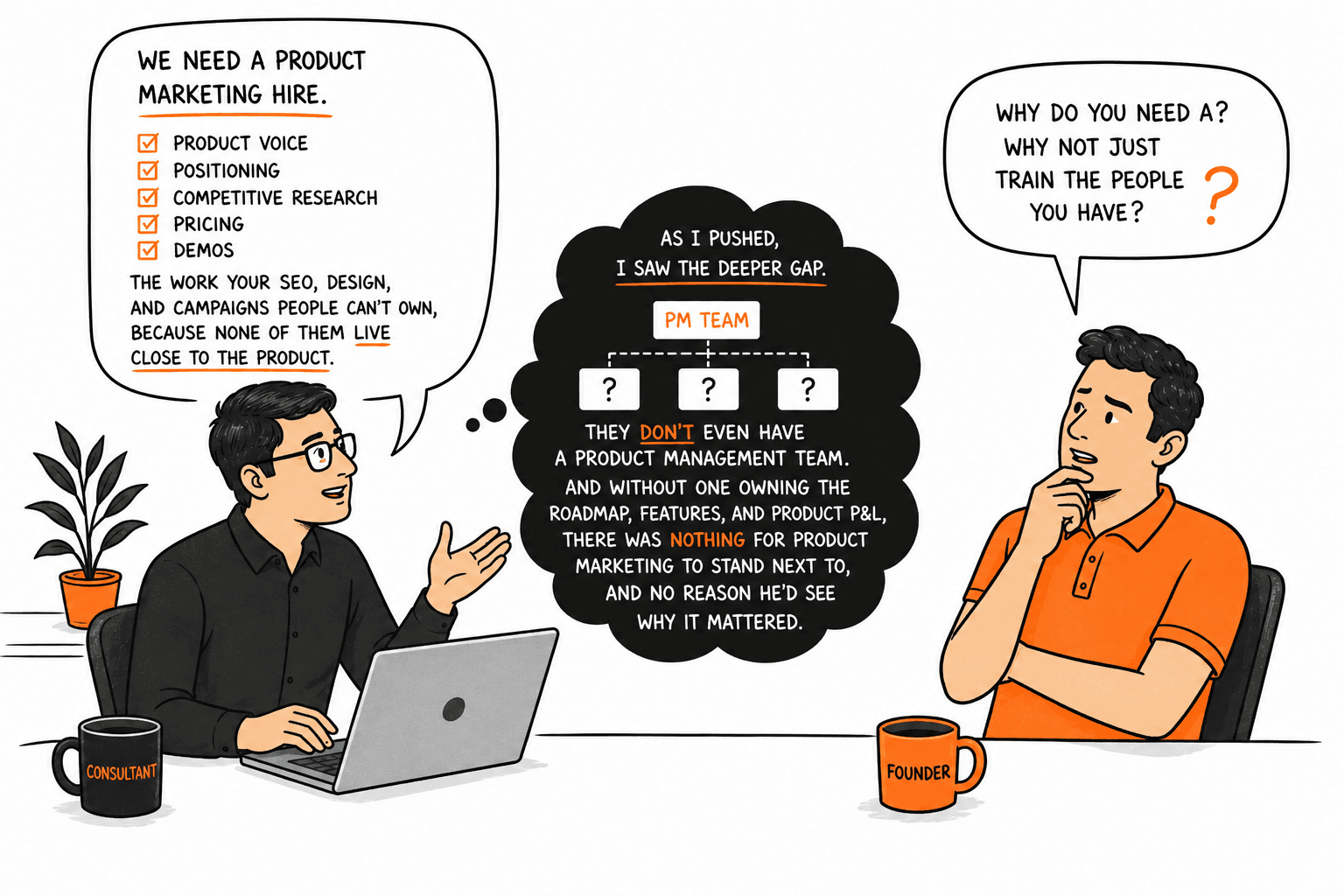
Early in an engagement, I told a first-time founder we needed a product marketing hire.
He asked me why. "You already have marketing people. Why this?"
So I explained it. Product voice. Positioning. Competitive research. Pricing. Demos.
The work my SEO, design, and campaigns people can't own, because none of them live close to the product.
He pushed back. "Then why not just train the people you have?"
And as I pushed, I saw the deeper gap.
They didn't even have a product management team.
And without one owning the roadmap, features, and product P&L, there was nothing for product marketing to stand next to, and no reason he'd see why it mattered.
If you've spent even three or four years inside a successful product company, you've seen the structure work. You don't need it justified. You've felt why it's there.
Without that background, none of it is obvious.
So every suggestion didn't read as a system. It read as one more ask.
I stepped away from that one.
The lesson:
Founders do their homework on you.
Do the same on them.
Before you sign on, have the real conversation. Understand their background and how they think.
Some things are non-negotiable, and it's far cheaper to learn that early than halfway in.
One insight
Your happiest customers are your best marketing. And it is almost free.
When you are small, the instinct is to push harder on outbound and spread yourself across a long list of prospects.
I would do the opposite.
Pick your first five or six customers and go deep. Deliver the outcome you promised.
Then extend the experience beyond the product. Be responsive. Listen. Solve the problem behind the problem. Go the extra mile.
That is how customers become champions.
Your happiest customers are your best marketing. And it is almost free.
Then ask for a video case study.
Not everyone will say yes, and that is fine. Two or three who are ready to back your growth is plenty.
One thing to keep in mind. B2B buying is rarely one person's call.
Gartner puts the typical buying group at five to sixteen people across as many as four functions.
So a strong customer story should capture those different points of view from the same purchase.
The buyer wants proof. And finance, security, and procurement each want confidence in their own seat.
That is issue one.
Reply and tell me what you are working on this week. I read every email.
Jaydip